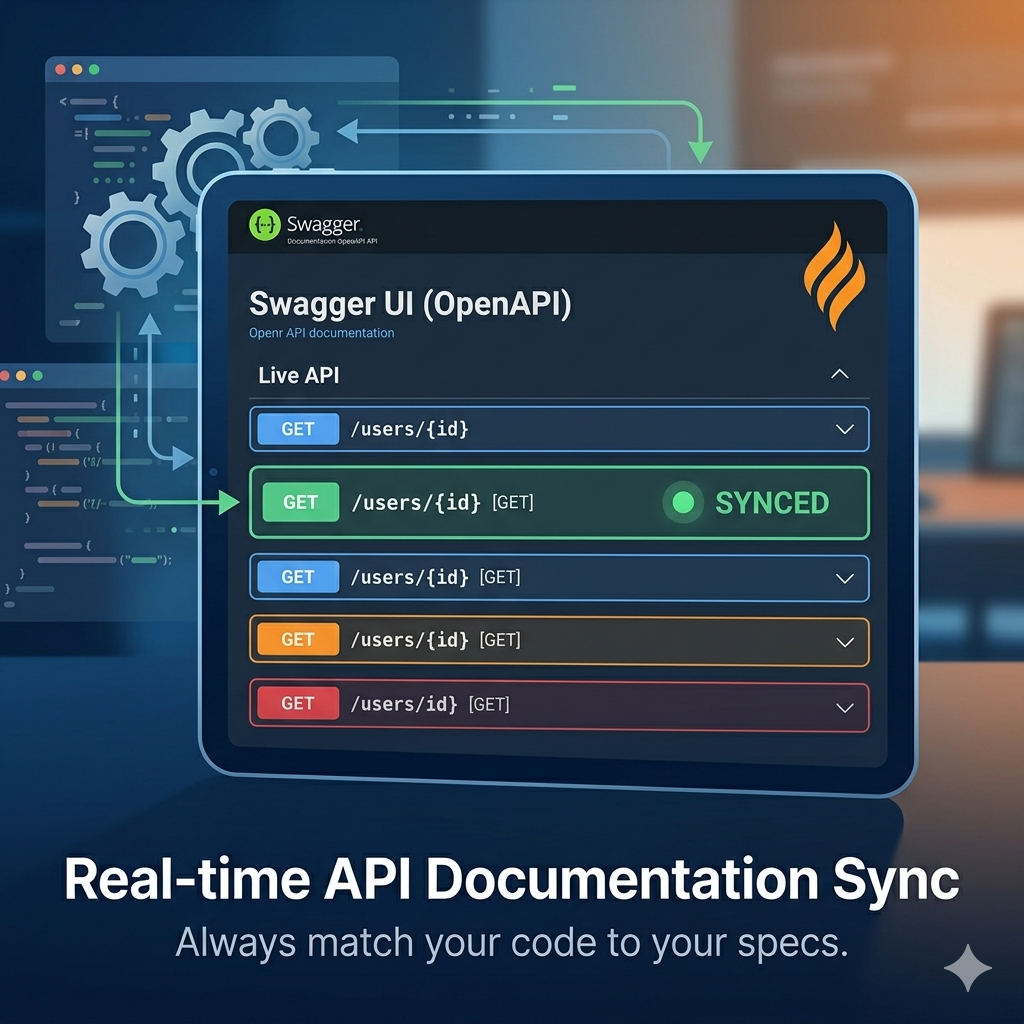
Updating the API documentation, whether it is an OpenAPI specification or a set of PDFs, is the universal chore that always gets pushed to the next sprint. Your code moves fast, but the documentation is stuck in the past. This disconnect is a classic pain point in traditional development, which is already known for being expensive, slow, and requiring specialized teams.
The False Promise of "Raw" AI
You might be thinking that the solution is to just throw generative AI at the problem. Have an AI read your codebase and spit out a Swagger file, right? Not quite. The reality of the current tech landscape is that generative AI, when left completely on its own, often produces JSON or code with syntax errors, incomplete schemas, or poorly thought-out permissions.
The elephant in the room is that AI can hallucinate or generate invalid JSON. If you ask it to build an entire backend and document it without any guardrails, you are essentially dealing with a brilliant chef who operates in a completely disorganized kitchen. The ideas are there, but the execution is messy and definitely not production-ready.
Enter Igniral: The Engine for the Lightning
If raw AI is a wild lightning bolt, Igniral is the electric motor that channels that energy into something usable. Igniral is a platform designed to generate production-ready backends with the speed of AI and the strict control of engineering.
The core value for development teams, frontend developers, and product managers is simple: Your Swagger documentation is never out of sync. Every single time you modify an endpoint, the interactive OpenAPI/Swagger documentation updates automatically to reflect the change instantly.
Igniral operates as a hybrid engine. This means you have 100% manual control when you need it. Whether you are scaffolding your initial data models using an AI prompt or tweaking an endpoint manually in the Visual Schema Builder, the resulting Swagger UI updates in real-time. You get a fully functional REST API with built-in JWT authentication, Role-Based Access Control (RBAC), and managed database infrastructure out of the box—without having to set up DevOps from scratch.
What Exactly is an API, and Why Does This Matter?
For the product managers and startup founders reading this: an API (Application Programming Interface) is the invisible engine that allows applications—like your mobile app or web dashboard—to read and write data in a standard way. It is the backbone behind food delivery orders, banking apps, and social networks. When developers don't have accurate documentation (the Swagger spec) explaining how to talk to this API, everything grinds to a halt. Igniral lowers the barrier by ensuring this contract is always perfectly written and instantly available.
How Igniral Works in 3 Steps
Instead of spending weeks setting up boilerplate, configuring JWTs, and manually writing OpenAPI YAML files, Igniral streamlines the process:
- Describe Your App: You simply describe your idea in natural language (English or Spanish). For example, "I need an app to manage reservations for my restaurant: tables, clients, menu, and payments".
- AI Generation & Strict Validation: The AI service (Vertex AI / Gemini) analyzes your prompt and generates the application definition, roles, dynamic endpoints (with kebab-case routing), JSON Schemas, and permissions. Here is the magic: Igniral's validation layers parse the JSON, apply structural validation, and if the AI hallucinated an invalid format, the system attempts automatic repair up to three times.
- Deploy & Use: The application, endpoints, and permissions are persisted into Igniral's infrastructure. Your API is immediately available on a custom subdomain (e.g.,
https://<subdomain>.igniral.io), and your Swagger/OpenAPI documentation is fully generated, interactive, and ready to use.
Beyond Documentation: Security by Design
Igniral does not just give you synced docs; it gives you a backend you can actually trust. A massive vulnerability in modern apps is file uploads. Uploading files without an antivirus is basically playing roulette. Igniral includes file storage with real-time malware scanning using ClamAV on every single upload. It operates on a zero-trust architecture: files go to quarantine, get scanned, and are only moved to a clean bucket if they are safe—otherwise, they are deleted.
Furthermore, you get a managed database with automatic backups and replication, plus a metrics dashboard showing total requests, average latency, and error rates.
Honest Limitations: What Igniral Doesn't Do
We believe in being upfront: Igniral is not a frontend code generator, and it does not replace the judgment of a developer or a product founder when it comes to complex, highly specific business logic. The quality of the generated backend heavily depends on the clarity of the user's prompt. Even with up to three repair attempts, the AI might still fail to generate a valid architecture if the context is too confusing. Igniral removes the repetitive, boring work, but it does not remove the need for human creativity and integration testing.
Stop Writing Outdated Specs
You don't need a massive DevOps team to launch your MVP, and you definitely don't need to spend your weekends updating Swagger files manually. Igniral provides the framework, the validations, and the automated syncing so you can focus on building your actual product.
Don't start from scratch. Start from production.
Describe your idea and see your API (with perfectly synced documentation) in minutes. Try it for free without a credit card at igniral.com.