Allowing users to upload files without rigorous scanning is essentially playing Russian roulette with your backend.
Whether it is an avatar picture for a new social network, a PDF invoice for an internal financial tool, or a medical certificate for a gym management app, file uploads are a massive attack vector for malware. If you rely solely on raw AI output to build these endpoints, you are likely deploying a ticking time bomb.
The Problem: AI Generates Code, Not Secure Architecture
We need to have a candid conversation about the reality of generative AI in software development. While large language models are incredible at scaffolding, they have distinct limitations. The AI can hallucinate or generate invalid JSON structures.
Think of generative AI as a brilliant chef working without an organized kitchen. The chef might chop vegetables at lightning speed, but without health standards or an organized workflow, the resulting dish might not be safe to consume. When an AI generates a file upload endpoint, it typically writes the basic logic to accept a multipart/form-data request and dump the file into a storage bucket. It rarely provisions a robust, isolated scanning environment.
If you are not an experienced DevOps engineer, setting up an isolated pipeline to scan incoming files for malicious code consumes weeks of repetitive, tedious work. And if you skip it, you are putting your entire user base and database at risk.
The Igniral Solution: Engineered Guardrails and Real Antivirus
This is where Igniral steps in to bridge the gap between AI speed and strict engineering control. Igniral is a backend copilot: the AI proposes the architecture, and Igniral validates, structures, and deploys it under rigorous rules.
Igniral does not just offer generic "secure storage". It provides real, verifiable security out of the box. For every file upload endpoint (designated as a FILE type), Igniral enforces a strict zero-trust architecture.
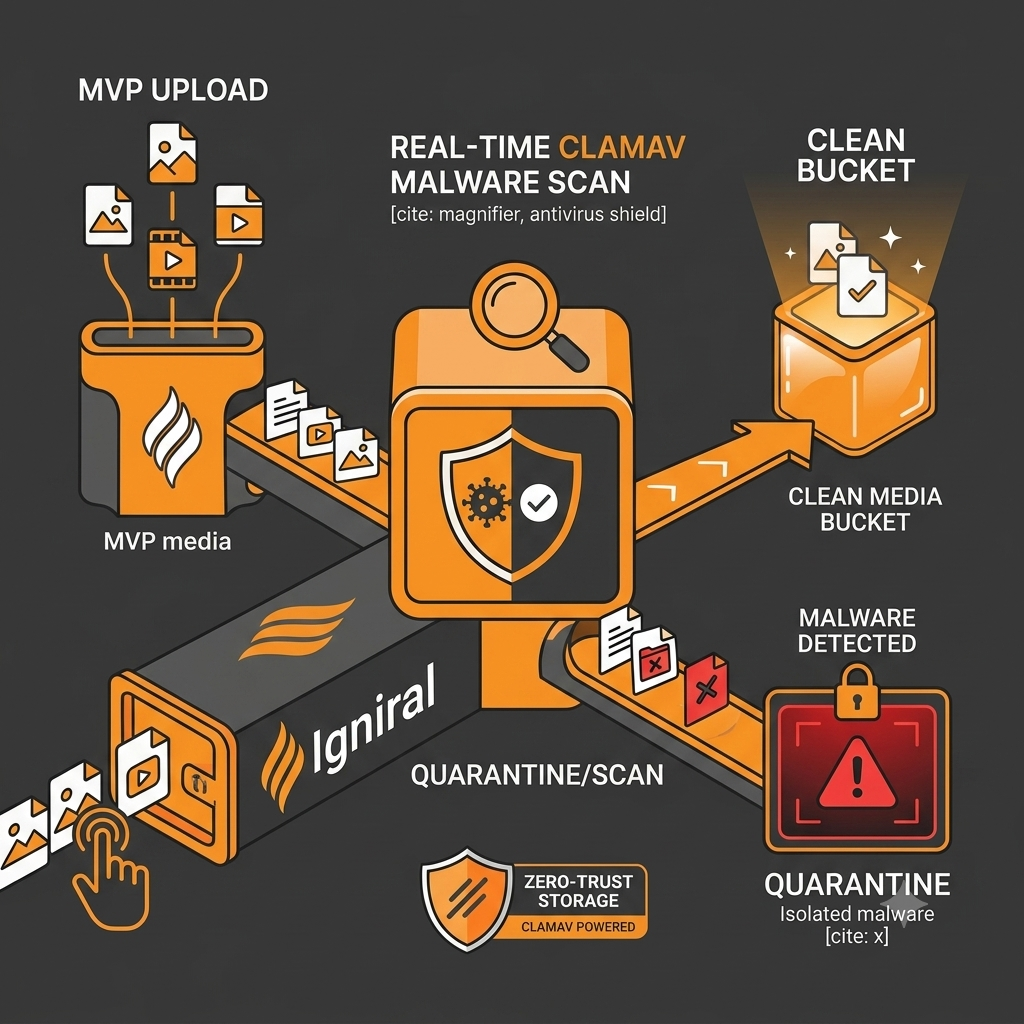
Here is exactly what happens when a user uploads a file to an Igniral-powered backend:
- Quarantine: The file is never trusted. It is immediately placed into an isolated quarantine zone.
- Real-Time Scan: Igniral executes a real-time malware scan using ClamAV on the quarantined file.
- Clean Bucket or Deletion: Only if the file passes the ClamAV scan is it moved to your application's clean media bucket. If it is infected, it is instantly deleted.
Additionally, Igniral's endpoints enforce structural validations, ensuring the file respects the maxSizeMB and allowedExtensions defined in your JSON Schema.
How to Build a Secure Backend in 3 Steps
If you are not deeply familiar with backend terminology, an API is simply an interface that allows apps (mobile, web, or other services) to read and write data in a standard way. It is the invisible engine behind food delivery apps, banks, and social networks.
Building a secure API with Igniral takes minutes, not weeks. Let's say you are building an internal app for a gym where members upload health certificates.
- Step 1: Describe. You type your idea into the prompt in natural language: "I need an app to manage gym memberships, including users, subscription plans, and a secure endpoint to upload PDF medical certificates".
- Step 2: Generate & Validate. The AI service analyzes your prompt and generates the application definition, roles, dynamic endpoints, and JSON Schemas. Before anything goes live, Igniral acts as a tireless reviewer. It validates the AI's output against strict rules. If the AI hallucinates an invalid JSON structure, Igniral attempts to repair it automatically (up to 3 times using a repair AI).
- Step 3: Use. Your backend is deployed. Your API is available on a custom subdomain (
https://<subdominio>.igniral.io), complete with integrated JWT authentication, Role-Based Access Control (RBAC), and Swagger/OpenAPI documentation that is always synchronized. Your ClamAV zero-trust storage pipeline is immediately active.
Control When You Need It
Igniral removes the repetitive boilerplate, but it never replaces the judgment of the developer or product founder. If you want to tweak the AI's output, Igniral provides a hybrid engine. You can jump into the Visual Schema Builder to manually define entities, types, HTTP methods, and visibility rules (like setting endpoints to PRIVATE or enforcing OWNER_ONLY access).
You don't need a massive DevOps team for your MVP. You just need the right platform to contain the lightning bolt of AI within a secure, engineered motor.
Igniral's Free plan allows you to explore the platform with 1 app, 5 schemas, 100 MB of storage, 50 users, and 2,000 API requests per day.
Don't let unsecured file uploads sink your startup before it even launches. Describe your idea and watch your API come to life in minutes. Start building today without a credit card at auth.igniral.com/subscribe or discover more at igniral.com.