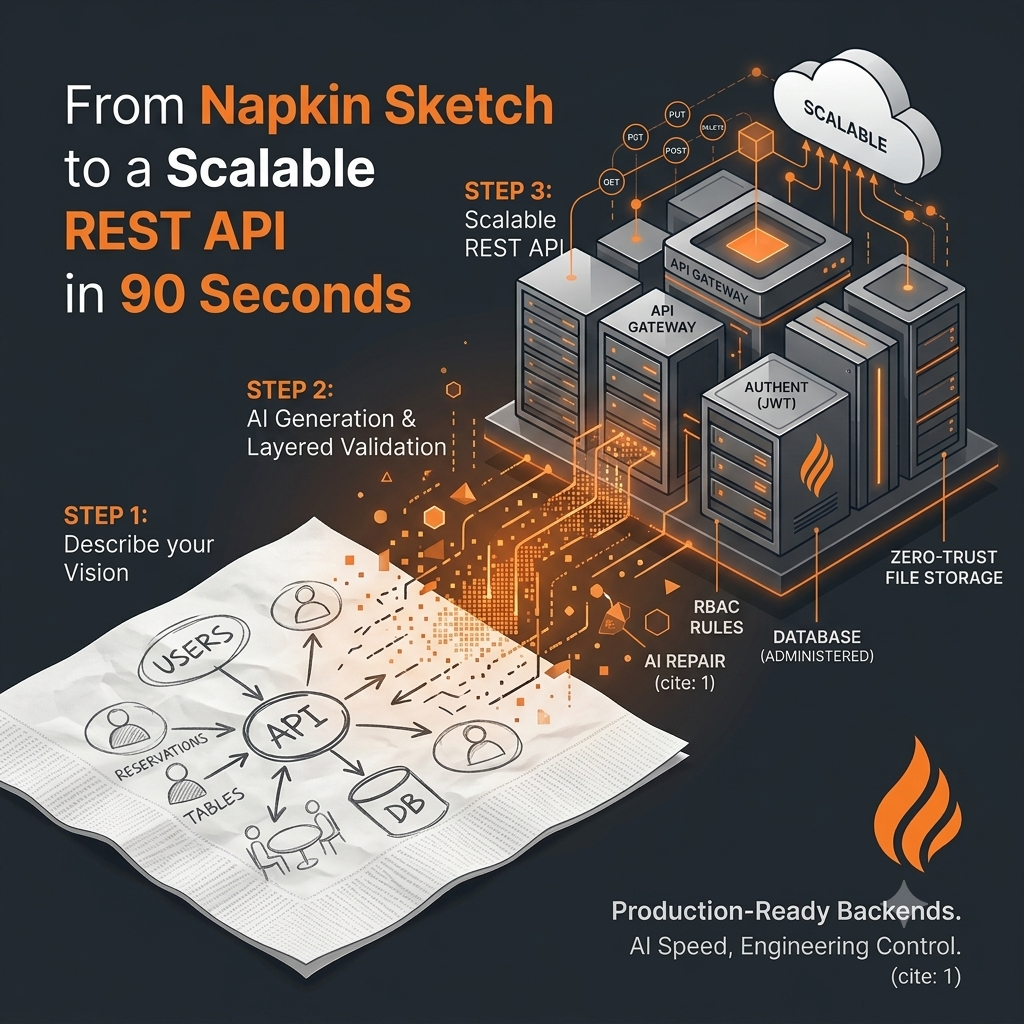
Building a traditional backend is notoriously expensive, incredibly slow, and requires a highly specialized team of developers. You have to configure databases, set up routing, write authentication logic, and secure your endpoints before you can even begin testing your core business idea.
Recently, the tech world has been flooded with promises that generative AI will simply write all this code for you. But if you have ever tried copying and pasting an AI-generated backend into your terminal, you know the unfiltered truth. Generative AI alone frequently produces JSON or code riddled with syntax errors, incomplete schemas, and permissions that are so poorly thought-out they are basically non-existent. It lacks the context and the strict structural boundaries required for a secure production environment.
You do not just need AI to write code; you need an engineered framework to validate it.
The Core Problem: The Brilliant but Careless Chef
Relying entirely on raw AI to build your backend infrastructure is like hiring a brilliant chef who refuses to organize their kitchen. The chef might have fantastic ideas and prep ingredients at record speed, but without health standards, standardized recipes, or a working stove, the final dish is a massive gamble.
When an AI hallucinates a backend architecture, it might forget to secure your user data or leave file upload endpoints vulnerable to malicious software. For instance, setting up secure file uploads is critical, as unchecked uploads are a massive attack vector for malware. Configuring JSON Web Token (JWT) authentication, user roles, and granular permissions for every single endpoint consumes weeks of repetitive, tedious work for human developers. Expecting a raw language model to perfectly orchestrate this on the first try is simply unrealistic.
The Solution: A Lightning Bolt Inside a Motor
This is exactly why Igniral was built. The platform was created by a founder who realized that AI tools generated code rapidly, but it was far too unstable for true production use. The core mission is to close the gap between the speed of AI and strict engineering control.
Igniral does not claim to be an AI that "does everything without human supervision". Instead, it acts as your backend copilot: the AI proposes the structure, but Igniral rigorously validates, structures, and deploys it according to hardcoded rules.
Think of Igniral as a system that channels the chaotic energy of AI inside a rigid framework of validations and production standards—much like capturing a raw lightning bolt inside an electric motor. It uses the same immense energy, but produces a completely different, highly controlled result (a usable backend).
For those who might not be deep into software engineering yet, an API (Application Programming Interface) is the standard interface that allows apps—like your mobile frontend or web dashboard—to read and write data. It is the invisible engine operating behind the scenes of food delivery apps, banking software, and social networks.
The 3-Step Flow: A Practical Case Study
Let's move from theory to practice. Imagine you want to build a platform to manage operations for a busy restaurant. You need to handle tables, customer data, menu items, and payment records.
With Igniral's Model Context Protocol (MCP) or direct Dashboard integration, you can go from that concept to a fully functional architecture in roughly 30 to 90 seconds. Here is the exact flow:
Step 1: Describe Your Vision
You do not need to write complex database schemas. You simply describe your idea in natural language (English or Spanish). For our case study, you would use a valid prompt like: "I need an app to manage reservations for my restaurant: tables, customers, menu, and payments".
Step 2: AI Generation and Layered Validation
Behind the scenes, the AI service (utilizing models like Vertex AI or Gemini) analyzes your prompt and generates a structured JSON output. It automatically defines:
- The Application: Name, description, context, and privacy settings.
- Base Roles: It creates minimum roles like Admin and User, adding more if the domain requires it.
- Dynamic Endpoints: It generates pluralized resources with English kebab-case routing (e.g.,
/api/order-items). - Data Contracts: It writes strict JSON Schemas (draft 2020-12) featuring typed properties and ID-based relationships.
But generation is only half the battle. Igniral then subjects this output to relentless layered validation. It parses the JSON, and if the AI hallucinated an invalid structure, Igniral attempts an automatic repair (up to 3 attempts using a dedicated repair AI). It ensures that your schemas have unevaluatedProperties: false at both the root and nested object levels to strictly prevent arbitrary fields from being injected.
The system also verifies that the AI hasn't improvised permissions at random; there are strict rules in the system prompt guiding roles and policies.
Step 3: Instant Deployment
Once the validation layers are cleared, the application, endpoints, and permissions are persisted in Igniral's managed infrastructure.
Within moments, your API becomes live on a custom subdomain: https://<subdominio>.igniral.io.
What You Actually Get "Out of the Box"
When that 90-second process finishes, you are not left with a folder of raw code you have to host yourself. You receive a managed, production-ready environment:
- Integrated Security: Full JWT authentication and Role-Based Access Control (RBAC).
- Always-Synced Documentation: Your OpenAPI/Swagger documentation is generated automatically and stays perfectly synced with every change you make.
- Zero-Trust Storage: Any file upload endpoints you create feature real-time malware scanning with ClamAV. Files go to quarantine, are scanned, and are only moved to a clean bucket if safe.
- Managed Database: Automatic backups and replication with zero Database Administrator (DBA) effort required from your side.
- Metrics Panel: A dashboard tracking total requests, average latency, and error rates.
And if you ever need to adjust what the AI built, Igniral features a hybrid engine. You have 100% manual control through a Visual Schema Builder to define entities, HTTP methods, and security policies by hand. The message is clear: AI plus humans. Igniral removes the repetitive work, not the creative control.
Stop Starting From Scratch
You do not need a massive DevOps team to launch your MVP. You just need the right tools to channel your ideas safely.
Igniral offers a Free plan that requires no credit card to start. It allows you to build 1 app with 5 schemas, 100 MB of storage, up to 50 users, and 2,000 API requests per day.
Stop starting from zero. Start from production. Describe your idea and watch your API come to life in minutes. Try it today at auth.igniral.com/subscribe or learn more at igniral.com.