But there is a catch. The moment you need a robust, production-ready backend to power that beautiful new user interface, the magic often stalls.
Generative AI is a fantastic brainstorming partner, but when left completely to its own devices, it can produce JSON or code with syntax errors, incomplete schemas, or poorly thought-out permissions. Building a traditional backend is still expensive, slow, and requires a specialized team.
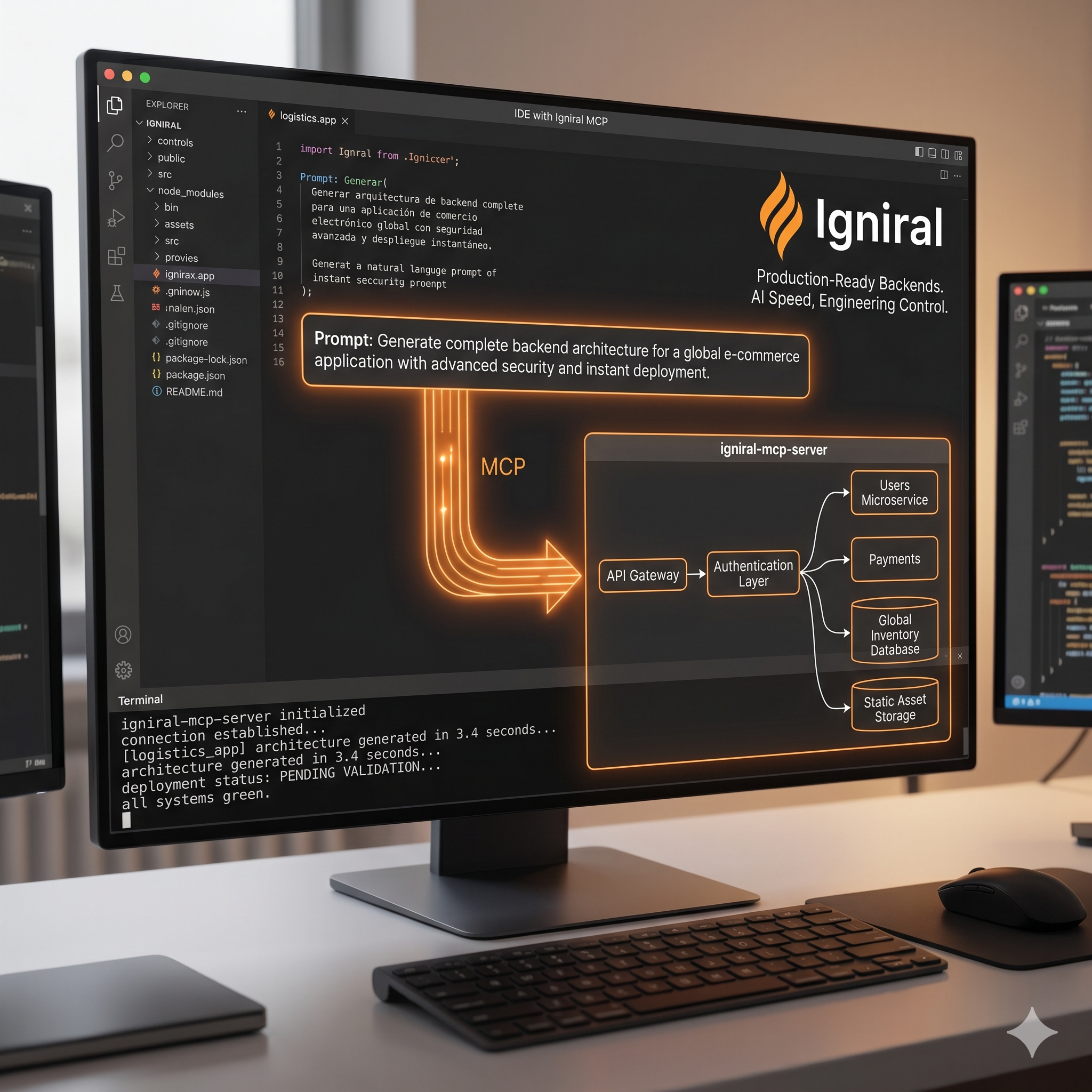
This is exactly where the Model Context Protocol (MCP) changes the game. By connecting your AI-powered IDE directly to a structured backend engine, you can move from a simple text prompt to a fully deployed architecture in minutes.
The Core Problem: AI is Brilliant, But Unpredictable
When you ask an AI assistant to "build a backend," you usually get a massive block of Express.js or Python code. It might look impressive at first glance, but try deploying it. You will quickly realize that the AI lacks the structural boundaries required for a secure production environment.
The AI might improvise permissions, forget to implement proper JSON schemas, or leave your file upload endpoints vulnerable to malware. You spend more time debugging the hallucinated code than you would have spent writing it yourself.
We need to rethink the relationship between AI and infrastructure. AI should not be writing raw, unverified backend boilerplate. Instead, AI should be channeled into a system with rules, validations, and production standards—like a lightning bolt safely contained within an electric motor.
Enter Igniral: AI Speed, Engineering Control
Igniral bridges the gap between the blazing speed of AI generation and the strict control of software engineering. It is not a frontend code generator, nor is it an AI that does everything without human supervision. Instead, Igniral acts as your backend copilot: the AI proposes the architecture, and Igniral validates, structures, and deploys it according to rigid rules.
If you are new to the concept, what is an API anyway? Simply put, an API is an interface that allows apps to read and write data in a standard way. It is the invisible engine behind food delivery apps, banks, and social networks.
With the release of the official igniral-mcp-server on npm, your favorite IDE can now communicate directly with Igniral. You no longer need to switch contexts or manually configure servers.
How the Igniral MCP Integration Works in 3 Steps
Using the igniral_generate_schema_from_prompt tool within your IDE (using your Agent API Keys from the Igniral Dashboard), the process is remarkably fluid:
- Describe Your App: You write a natural language prompt directly in Cursor or Claude. For example: "I need an app to manage reservations for my restaurant: tables, customers, menu, and payments."
- AI Scaffolding: The AI analyzes your prompt and generates the application definition, base roles (like Admin and User), dynamic endpoints in kebab-case, JSON Schemas with typed properties, and granular permissions for each HTTP method.
- Strict Validation & Deployment: This is where Igniral shines. The system validates the AI's response. If the JSON is invalid, it attempts automatic repair up to 3 times using a dedicated repair AI. Once validated, the API is persisted and made instantly available on a subdomain.
The entire process takes roughly 30 to 90 seconds.
Out-of-the-Box Infrastructure: What You Actually Get
"Production-ready" is a heavy promise, but Igniral delivers the concrete infrastructure you need to launch securely:
- Dynamic CRUD Endpoints: You get a complete REST API with endpoints based on JSON Schema (draft 2020-12).
- Integrated Security: The platform includes built-in JWT authentication and Role-Based Access Control (RBAC).
- Always-Synced Documentation: Forget about manually updating your docs; the Swagger/OpenAPI documentation updates automatically with every single change you make.
- Managed Database: Igniral handles the database with automatic backups and replication, requiring zero DBA effort.
- Zero-Trust File Storage: File uploads are a massive attack vector. Igniral includes real-time malware scanning with ClamAV on every upload. It uses a zero-trust architecture: files go to quarantine, get scanned, and are only moved to a clean bucket if safe.
- Metrics Dashboard: You get a dashboard tracking total requests, average latency, error rates, and top endpoints.
The Reality of AI (And Why Validation Matters)
The AI can hallucinate or generate invalid JSON. The quality of your backend still heavily depends on the clarity of your prompt.
Igniral protects you with layered validation: JSON parsing, AI repair, structural validation, plan limit checks, persistence, and finally, runtime validation. The AI does not randomly improvise permissions; it follows strict rules dictated by the system prompt, enforcing standard roles, security policies, and English kebab-case paths.
And if you ever want to step out of the AI flow, Igniral features a hybrid engine. You have 100% manual control through a Visual Schema Builder where you can define entities, types, HTTP methods, and security policies by hand.
Who Is This For?
Whether you are a developer using Cursor who wants to skip the boilerplate, or a startup founder needing a backend before your pitch deck is even finished, Igniral gives you the tools to move fast without breaking things.
You don't need a massive DevOps team for your MVP. You just need a chef working in an organized kitchen with approved ingredients.
Ready to experience automation that meets precision? Igniral has a Free plan that allows you to manage 1 app with 5 schemas, 100 MB of storage, 50 users, and 2,000 API requests per day.
Stop starting from scratch. Start from production. Describe your idea and watch your API come to life in minutes—start without a credit card at auth.igniral.com/subscribe. Discover more at igniral.com.