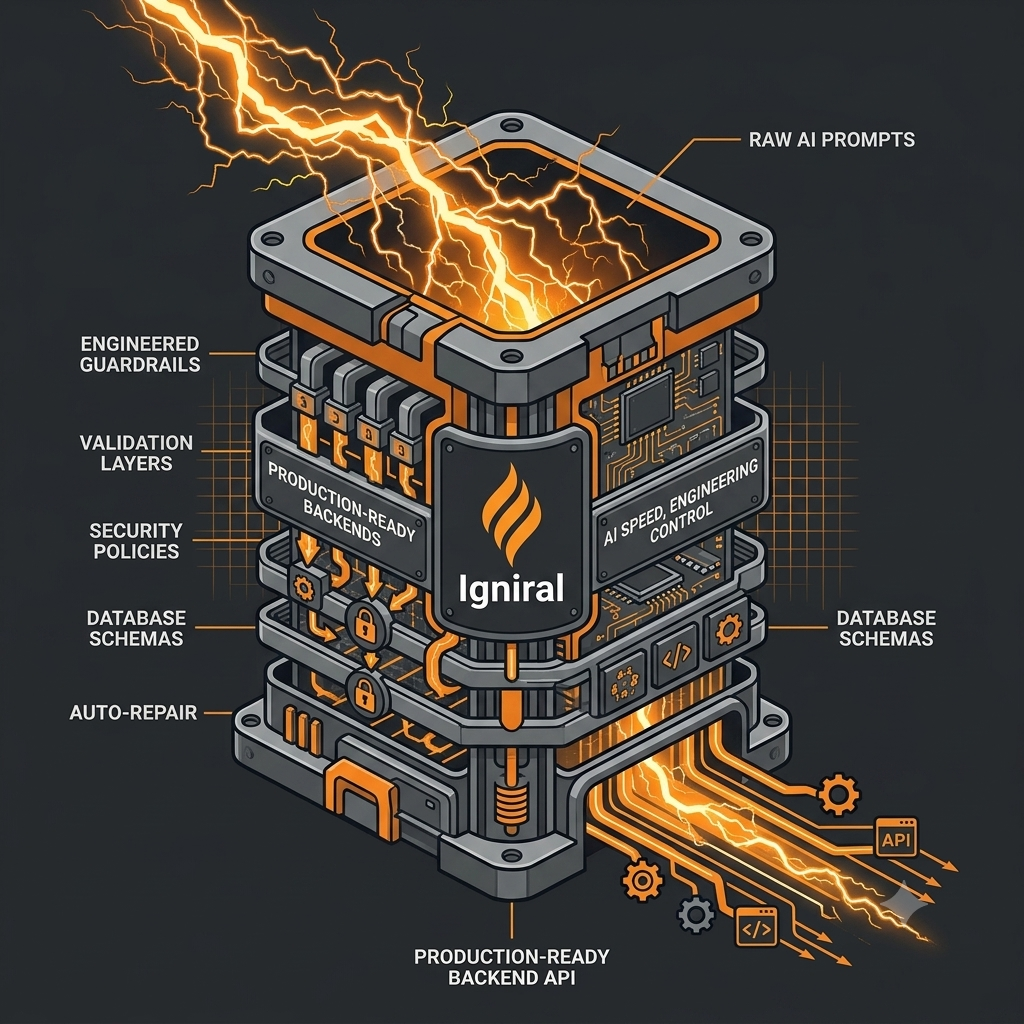
There is a significant gap between "code that looks right on a screen" and "code that survives contact with actual users." Building a traditional backend from scratch is notoriously expensive, slow, and requires a specialized team of developers. Generative AI promises to fix this, but generative AI alone often produces JSON or code fraught with syntax errors, incomplete schemas, and poorly thought-out access permissions.
The reality is that AI can hallucinate or generate invalid JSON structures when left to its own devices. Relying entirely on raw AI to structure your database and security layers is a gamble.
The Problem: The Chef Without a Kitchen
Think of raw generative AI as a brilliant chef working without an organized kitchen. The chef has incredible ideas and can chop vegetables at lightning speed, but without health standards, organized ingredients, or a proper stove, the resulting dish might be brilliant—or it might give your customers food poisoning.
When an LLM improvises an API, it often fails to understand the rigid boundaries required for enterprise-level security. It might forget to validate payloads, or worse, leave your file upload endpoints wide open. File uploads are a massive attack vector (often involving malware) if they are not rigorously scanned. Setting up the necessary safeguards—like JSON Web Token (JWT) authentication, roles, and granular permissions per endpoint—traditionally consumes weeks of repetitive work.
You don't just need AI; you need guardrails.
The Solution: A Lightning Bolt Inside a Motor
This is exactly why Igniral was built. Igniral does not claim to be an AI that "does everything without human supervision". Instead, it acts as a backend copilot where the AI proposes the architecture, but Igniral validates, structures, and deploys it under strict engineering rules.
Igniral channels the raw power of AI inside a system with rules, validations, and production standards—much like capturing a lightning bolt inside an electric motor. It takes the same raw energy (the AI) and transforms it into a completely different, highly usable result (a production-ready backend). Igniral provides the organized kitchen with approved ingredients and standardized dishes.
The Unforgiving Validation Layers
How does Igniral prevent the AI from making catastrophic mistakes? Through an exhaustive, multi-layered validation system:
- Parsing & AI Repair: When the AI generates the backend schema, the system first parses the JSON. If the JSON is invalid, Igniral doesn't just crash; it attempts automatic repair using a dedicated repair AI (up to 3 attempts).
- Structural Validation: The AI does not improvise permissions at random. There are strict rules baked into the system prompt enforcing roles, role permissions, security policies, and paths formatted in English kebab-case.
- Strict Data Contracts: The generated JSON Schemas (draft 2020-12) include
unevaluatedProperties: falseat both the root and nested object levels. This ensures that arbitrary, unapproved fields cannot be injected into your database. - Runtime Protection & Antivirus: Igniral includes real-time malware scanning with ClamAV on every single file upload. It operates on a zero-trust architecture: files go into quarantine, get scanned, and are only moved to a clean bucket (or deleted if infected).
How It Works in 3 Steps
For those newer to backend development, an API is simply an interface that allows apps (like mobile or web apps) to read and write data in a standard way—it's the invisible engine behind food delivery apps, banks, and social networks. Igniral lowers the barrier to creating them through a simple flow:
- Step 1: Describe. The user describes their idea in natural language (in Spanish or English). For example: "I need an app to manage reservations for my restaurant: tables, customers, menu, and payments".
- Step 2: Generate. The AI service analyzes the prompt and generates the application definition, roles (minimum Admin and User), dynamic endpoints, schemas with typed properties, and access policies. Endpoints can be secured with policies like
NONE(shared data),OWNER_ONLY(users only see what they created), orCLAIM_FILTER(access via JWT claims). - Step 3: Deploy. Once validated, the application, endpoints, and permissions are persisted in Igniral's infrastructure. Your API becomes instantly available on a subdomain:
https://<subdominio>.igniral.io.
Furthermore, your OpenAPI/Swagger documentation is generated automatically and is never out of sync, as every change updates the spec immediately.
The Hybrid Approach: You Are In Control
The ultimate goal is not AI replacing humans; the core message is AI plus humans. Igniral removes the repetitive, boilerplate tasks but leaves the creative control to you. If you need to step out of the AI flow, Igniral offers a hybrid engine. You have 100% manual control through a Visual Schema Builder where you can define entities, types, HTTP methods, and security policies by hand.
You don't need a massive DevOps team to launch your MVP. You just need the right guardrails.
Igniral offers a Free plan allowing you to build 1 app with 5 schemas, 100 MB of storage, 50 users, and 2,000 API requests per day. Describe your idea and watch your API come to life in minutes. Start without a credit card at auth.igniral.com/subscribe or learn more at igniral.com.