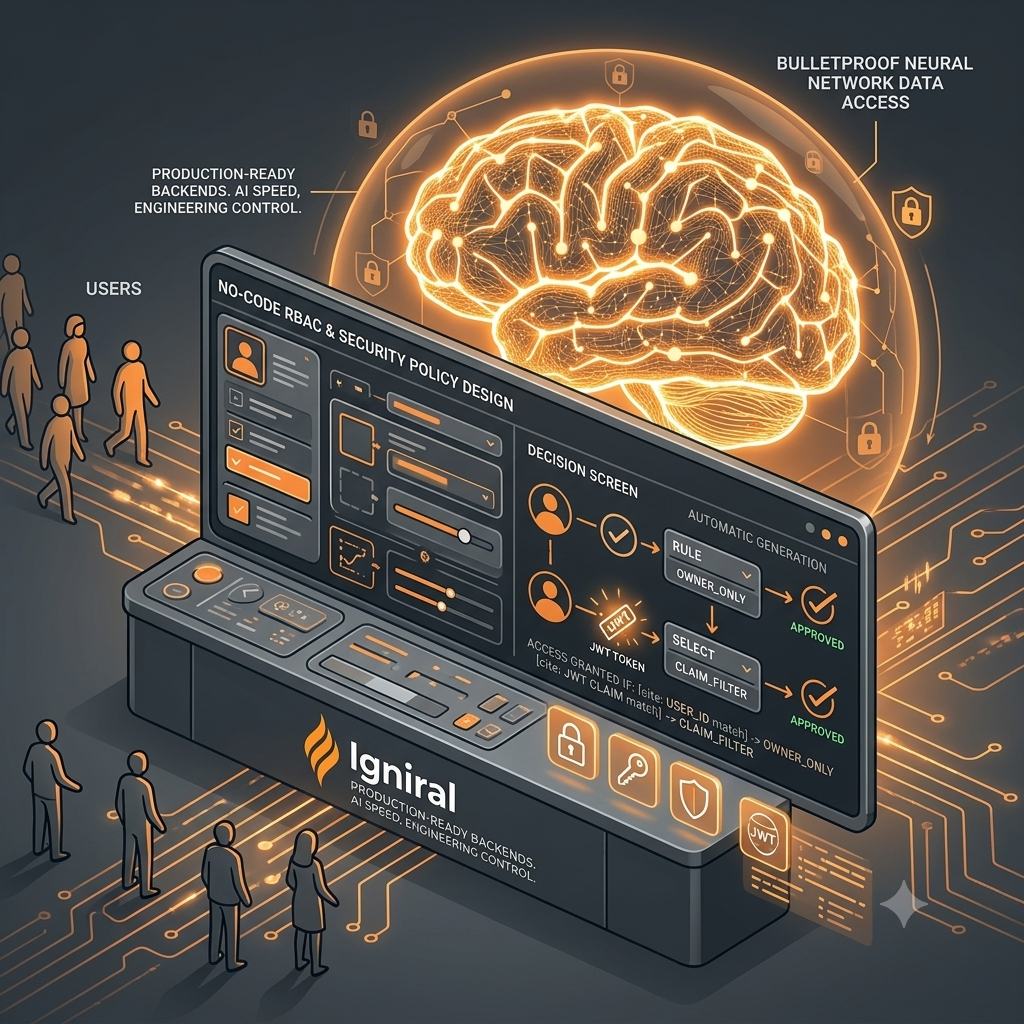
Configuring JSON Web Token (JWT) authentication, user roles, and granular permissions for every single endpoint traditionally consumes weeks of repetitive, tedious work. It is not just about writing code; it is about writing secure, bulletproof code that prevents data leaks.
In the rush to deploy, many teams turn to generative AI to write these permission layers. This is a risky game.
The Problem: AI Improvisation is Dangerous
Generative AI is a fantastic brainstorming tool, but relying on it to structure real databases and access permissions is a recipe for disaster. The AI can hallucinate, and generative AI alone often produces code with incomplete schemas or poorly thought-out permissions.
Think of generative AI as a brilliant chef working without an organized kitchen. The chef might create an incredible recipe, but if they are grabbing unverified ingredients and bypassing health codes, the resulting dish is unsafe. When an AI hallucinates access controls, it might accidentally expose sensitive user data to the entire internet.
We need to stop asking "AI versus humans" because that is the wrong question. The real magic happens when we combine AI speed with human engineering control. You need the AI to move fast, but you need strict guardrails to stay safe.
The Solution: A Lightning Bolt Inside an Electric Motor
Igniral bridges the gap between the blazing speed of AI and the strict control of software engineering. Igniral is not an AI that "does everything without human supervision". Instead, it channels the AI within a system of rules, validations, and production standards—acting just like an electric motor containing a powerful lightning bolt.
Right out of the box, Igniral provides integrated JWT authentication and Role-Based Access Control (RBAC). The AI does not improvise these permissions at random; there are strict rules in the system prompt dictating roles, role permissions, and security policies.
Deep Dive: Security Policies Generated by AI
When you describe your application, Igniral's AI engine automatically scopes out the necessary roles (with a minimum of Admin and User, adding more depending on your domain) and assigns strict security policies to each endpoint.
These policies are not generic. They are highly specific, enterprise-grade access rules:
- NONE: This policy is used for shared data. Think of product catalogs, tag lists, or public blog posts where any authenticated user (or unauthenticated, depending on visibility) can read the data.
- OWNER_ONLY: This is the cornerstone of multi-user applications. With
OWNER_ONLY, each user can only see or modify the records they personally created. For example, in an invoicing app, a user will only see their own invoices, while Admins retain the ability to see everything. - CLAIM_FILTER: This policy allows for advanced access control based on JWT claims. It is perfect for multi-tenant architectures or assigning specific tasks to specific staff members based on the claims embedded securely in their token.
Furthermore, Igniral enforces visibility rules at the endpoint level, dividing them into PUBLIC and PRIVATE. If your application is marked as private, Igniral enforces that all generated endpoints remain strictly private, preventing accidental data exposure.
What is an API? (And Why You Need a Secure One)
If you are a product founder transitioning into technical architecture, you might be wondering how all this fits together. An API is an interface that allows apps (like a mobile app or a web dashboard) to read and write data in a standard way. It is the invisible engine behind food delivery apps, banks, and social networks. Securing this engine is non-negotiable.
How to Deploy Bulletproof RBAC in 3 Steps
Igniral acts as a tireless reviewer that validates, corrects, and secures your API. Here is how the flow actually works:
- Describe Your Logic: You describe your application in natural language (English or Spanish). Example: "I need an app to manage reservations for my restaurant: tables, customers, menu, and payments".
- Generate and Validate: The AI (using models like Vertex AI or Gemini) generates the app definition, dynamic endpoints in English kebab-case, and strict JSON Schemas. It assigns the appropriate
OWNER_ONLYorNONEpolicies. Igniral then validates the JSON output; if the AI hallucinates an invalid structure, Igniral attempts to repair it up to 3 times automatically. - Use Your Secure Backend: Your API is instantly available on a custom subdomain (
https://<subdominio>.igniral.io). Your OpenAPI/Swagger documentation is generated automatically and stays perfectly synchronized with every change you make.
Total Control with the Hybrid Engine
While AI scaffolding is fast, the quality of the result depends heavily on the clarity of your prompt. Sometimes, business logic is too complex for a single prompt.
Igniral offers a hybrid motor. You have 100% manual control whenever you want it. Using the Visual Schema Builder, you can manually define entities, tweak HTTP methods, adjust visibility, and change security policies from NONE to CLAIM_FILTER with a few clicks. You get the speed of AI without sacrificing the judgment of the developer.
Secure Your Data Today
You do not need a massive DevOps team to build a secure MVP. You just need automation that meets precision.
Igniral offers a Free plan to help you explore the platform without risk. This plan includes 1 app, 5 schemas, 100 MB of storage, 50 users, and 2,000 API requests per day.
Stop wasting weeks writing repetitive authentication boilerplate. Describe your idea and watch your secure API come to life in minutes. Start building without a credit card at auth.igniral.com/subscribe and learn more at igniral.com.